On-Metal NFC Epoxy Tag
• Anti-metal Technology: Exclusive anti-metal shielding design, stable reading on metal surfaces.
• Chip Technology: Operating frequency 13.56MHz, supports NFC Forum Type 2/4/5 standards.
• Communication Protocol: ISO/IEC 14443, compatible with all NFC smartphones.
• Materials and Process: Industrial-grade epoxy resin encapsulation, IP68 protection rating, waterproof, dustproof, and corrosion-resistant.
• Tag Size: Multiple standard sizes available, supports customized miniaturization designs.
• Customization Services: Supports color printing, serial number customization, and laser engraving.
• Company Advantages: WS RFID provides a complete solution for anti-metal special tags.
• Quality Certifications: Certified by RoHS, REACH, CE, and other international standards.
• Lead Time: 5-7 days for in-stock products; 10-12 days for products not in stock.
On-Metal NFC Epoxy Tag for Industrial & Asset Tracking
The WS RFID On-Metal NFC epoxy tag is designed to be deployed on metal surfaces where conventional NFC stickers cannot be used. It works at 13.56 MHz and supports ISO/IEC 14443 protocol. To avoid eddy current interference, it applies high-permeability ferrite isolation layer to deflect the magnetic field away from metal surface. It is encapsulated in industrial grade epoxy resin with IP68 classification and functions at temperatures from -25°C to +85°C and has storage choices ranging from 144 bytes to 888 bytes.
Why Standard On-Metal NFC Epoxy Tag Fail on Metal?
If you put a normal NFC tag on a metal surface, the eddy currents induced by the metal will cancel out the electromagnetic field from the reader and there will be no communication.
This On-Metal NFC Epoxy Tag solves the issue on the hardware level. Between the antenna and the metal surface is a ferrite shielding layer with high permeability, usually 0.1 mm to 0.5 mm thick. This layer redirects the magnetic field upwards, so the signal remains legible.
The epoxy resin encapsulating is RF transparent and does not affect the NFC transmission. Read performance is a function of antenna size and ferrite quality.
Key Product Specifications
| Parameter | Details |
|---|---|
| Operating Frequency | 13.56 MHz (HF) |
| Communication Protocol | ISO/IEC 14443, NFC Forum Type 2 / 4 / 5 |
| Chip Model | NXP NTAG213 / NTAG215 / NTAG216, DESFire EV2 / EV3 |
| Read Distance | 0–10 cm (optimized for metal surfaces) |
| Storage Capacity | 144 bytes / 504 bytes / 888 bytes |
| Encapsulation Material | Industrial-grade epoxy resin |
| Protection Rating | IP68 |
| Operating Temperature | -25°C to +85°C |
| Mounting Method | 3M 300LSE or VHB adhesive; screw fixing available |
| Minimum Size | Down to 8 mm diameter |
| Printing Process | Silk screen, laser engraving, serial number |
| Size Options | Multiple standard sizes; custom sizes supported |
Material and Construction
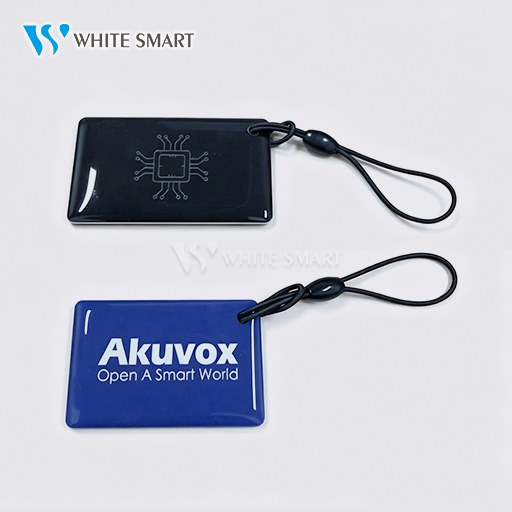
The epoxy encapsulation has a protective and aesthetic purpose. The CMYK or silk-screen print is put under the epoxy layer. This protects the artwork from scratches and chemical cleaning agents, and gives a clear, high gloss surface finish after extended field usage.
The adhesive backing has 3M 300LSE or VHB high strength adhesive for bond stability on textured or low surface energy metallic surfaces under vibration. Screw fastening holes are provided for permanent installation.
This flexible epoxy formulation is intended to withstand breaking from thermal expansion and contraction during several heat cycles.

Quality Control Process
WS RFID will do 5 tests on each batch of manufacturing before shipping.
Resonance Frequency Test - The tag is tested on metal using a network analyser to verify that the tag is tuned at 13.56 MHz. Off-frequency tuning immediately reduces read range.
Read Range Benchmarking – Tags are scanned on aluminium, steel and copper surfaces to confirm the minimal read distance required under usual conditions.
Salt Spray Testing — 48 to 96 hours salt spray test verification of epoxy encapsulant and internal ferrite layer for resistance to delamination and corrosion.
UV Ageing Test - Accelerated UV exposure to confirm the epoxy stays clear, without yellowing or breaking after long term outdoor usage.
Write/Read Endurance Cycle — Tests chip data retention and EEPROM integrity for 100,000 read/write cycles to track assets across their life cycle.
<0.3% manufacturing failure rate may be achieved using automation in packaging.

Application Scenarios
Industrial Asset Management – monitor equipment, moulds and tools in production settings susceptible to lubricants, abrasion and temperature variations. Each tag has identifiers connected to maintenance records and geographical information.
Metal Containers and Cylinders – Used on chemical drums, gas cylinders and metal storage boxes for quick identification and inventory accuracy.
Automotive Parts Traceability – Attach to engine components and chassis parts to provide traceability from production to end-of-life.
Medical Devices – Identification and tracking of metal surgical instruments during sterilisation cycles to enhance compliance and prevent loss
Outdoor Infrastructure – For steel utility poles, fire hydrants and metal public signs for maintenance recording and mobile based digital interaction use.
Electronics with Metal Cases – Introduce traceability to consumer electronics, connecting physical objects to digital data.
Access Control – Embed in metal door frames or intercom systems for secure mobile tap access in business buildings.

Customization and OEM/ODM Services
The complete customisation of the WS RFID for the On-Metal NFC Epoxy Tag includes size, shape, chip model, storage capacity, mounting technique, surface printing. Designs may be miniaturised down to 8mm diameter for space-constrained applications.
Supported chip choices are NTAG213 (144 bytes), NTAG215 (504 bytes), NTAG216 (888 bytes) and DESFire EV2/EV3. Your chip choice relies on your storage, security and compatibility needs.
Functional prototypes ready within 7 working days. MOQ begins at 500 pcs. In-stock orders ship in 5-7 days Custom orders ship in 10-12 days.
All items are covered by a 1 year guarantee and are RoHS, REACH, CE, FCC and ISO 9001:2015 Certified.

FAQ
Q: Why is this tag thicker than a regular NFC sticker?
A: It has a ferrite shielding layer, generally 0.1 mm to 0.5 mm thick. This redirects the magnetic field so that metal does not absorb the signal. It is this layer that allows reliable on-metal reading.
Q: Will this tag work on surfaces other than metal?
A: Yes. It is optimised for metallic surroundings but works well on plastic, wood and other non-metal materials as well.
Q: Does epoxy resin decrease NFC signal quality?
A: No. The epoxy resin is RF transparent. The read range depends on the antenna size and the quality of the ferrite layer.
Q: Will the print be protected from damage?
A: Yes. The print is put behind the epoxy layer and protects it from scratches, solvents and chemical cleaning agents.
Q: What will happen if the epoxy cracks?
A: If the epoxy is breached, moisture might get in contact with the ferrite layer or antenna. WS RFID employs a flexible epoxy developed to withstand thermal expansion and contraction which reduces the chance of breaking under typical working circumstances.
Q: What chips do you have?
A: NTAG213 (144 bytes), NTAG215 (504 bytes), NTAG216 (888 bytes) and DESFire EV2/EV3. It is contingent upon what you require for storage, security and compatibility.
Contact Us
Do you have more questions about On-Metal NFC Epoxy Tag? Reach out at kenny@w-srfid.com to discuss sample availability or a custom order.