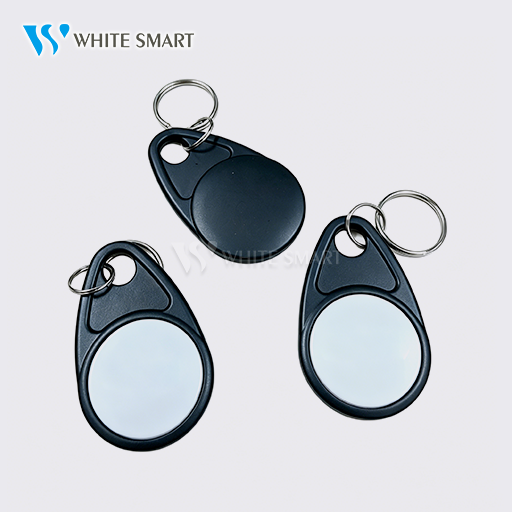
RFID Key Fob
• Chip Technology: Utilizes RFID technology, operating frequency 125kHz (LF low frequency) or 13.56MHz (HF high frequency).
• Communication Protocol: ISO14443A, 15693, etc.
• Customization Services: Supports brand logo printing, personalized coding, and custom sizes.
• Security Features: Encrypted data transmission, anti-copying and anti-cloning, secure and reliable.
• Company Advantages: WS RFID provides a one-stop service from chip selection to finished product delivery.
• Quality Certification: Certified by RoHS, REACH, and other international environmental protection standards.
• Lead Time: 5-7 days for in-stock products; 10-12 days for products not in stock.
• Application Scenarios: Hotel access control, corporate attendance systems, residential community access control, etc.
RFID Key Fob for Access Control — Secure, Durable & Fully Customizable
RFID Key Fob technology provides you with contactless identification without mechanical wear or audit gaps. WS RFID has been producing access control credentials since 2008 and has a facility of more than 10,000 sqm with an annual production of more than 500 million units. Each fob supports 125kHz or 13.56MHz frequencies, read distances of 5-15cm, data retention of 10+ years, and 100,000+ write cycles. The fault rate of the manufacturing line is less than 0.1%. The goods are certified to ISO 9001:2015, CE, FCC, RoHS and REACH standards.
What Makes This RFID Key Fob Different?
Standard mechanical keys may wear out over time, can be duplicated without authorisation, and leave no trace of use. An RFID-based credential overcomes all three difficulties by using a single contactless chip-and-antenna architecture.
The data communication is by electromagnetic fields and not physical touch thus there is no mechanical wear on the fob or reader. The system automatically logs every access event, providing a clear record of the time, place and credential ID of entrance.
For example, HF fobs with MIFARE DESFire technology use AES-128 bit encryption at the protocol level, making them more harder to copy without authorisation than the simpler 125kHz credentials.
Technical Specifications
| Parameter | Details |
|---|---|
| Operating Frequency | 125kHz (LF) / 13.56MHz (HF) |
| Communication Protocol | EM4100, ISO/IEC 14443A, ISO 15693 |
| Read/Write Distance | 5–15 cm |
| Storage Capacity | 1KB / 4KB / 8KB EEPROM |
| Data Retention | 10+ years |
| Write/Erase Cycles | 100,000+ |
| Operating Temperature | -25°C to +70°C |
| Shell Material | ABS / Silicone |
| Printing Process | Offset, screen, digital (full-color CMYK) |
| Chip Options | NXP MIFARE, DESFire, NTAG, ICODE, Hitag, Fudan, Huada |
| Defect Rate | < 0.1% |
| Certifications | ISO 9001:2015, CE, FCC, RoHS, REACH |
Key Product Features
Impact-Resistant Encapsulation
The ABS or silicone casing protects the internal antenna-chip bond from drops, torsion and ordinary handling. The bond integrity is verified by drop testing from 1.5 meters onto concrete before a design is certified for manufacturing.
Wide temperature range
The RFID Key Fob can work from -25°C to +70°C, making it suitable for most indoor and semi-outdoor access control scenarios. Where there's exposure to heat, there are UV-stabilized shell materials that will prevent the shell from becoming brittle over time.
Flexible choice of chips
Options include NXP MIFARE Classic, DESFire, NTAG, ICODE, Hitag and indigenous chips from Fudan and Huada Microelectronics. This range allows you to adapt the fob to your current reader platform and security needs, without changing infrastructure.
A keychain-sized form factor
It is designed to suit regular key rings and lanyards. We provide a variety of housing moulds based on your carrying choice or system design.

Where Is It Used?
- Corporate Access Control — Employee attendance, multi-zone permissions, restricted area management
- Residential Communities — Resident entry, visitor registration, elevator control
- Hotels — Guest room access, floor-level authorization
- Campus Management — Dormitory entry, library and lab access
- Parking Systems — Vehicle gate control, parking space management
- Industrial Parks — Production zone access, equipment management
- Government & Financial Institutions — Secure area control, document management
For environments such as water parks and gyms, the waterproof silicone variant handles continuous exposure to chlorine, moisture, and sweat without performance loss.

Quality Control Process
Every RFID Key Fob production batch goes through a structured inspection sequence before shipment:
- Frequency Testing — Network analyzers confirm resonance within ±3% tolerance for HF fobs
- Mechanical Durability — Drop tests from 1.5m and torsion tests verify internal antenna bond integrity
- Environmental Stress Screening — Salt spray testing and thermal cycling from -25°C to +70°C
- Read Range Verification — Performance confirmed across multiple reader power levels
- UID Uniqueness Check — Duplicate IDs are screened out within every batch
- 100% EEPROM Functional Testing — Every memory sector is tested before the product ships
WS RFID uses Muehlbauer bonding lines and Voyantic Tagformance testing systems on the production floor — equipment commonly used in high-volume industrial card manufacturing.

Customization & OEM/ODM Support
Standard MOQ is 500 units. Stock samples are available at no charge. Functional prototypes can be ready within 7 working days. Lead time is 5–7 days for in-stock configurations and 10–12 days for custom orders.
Customization options include:
- Logo & Graphics — Full-color CMYK printing via offset, screen, or digital methods
- Chip Pre-encoding — UID writing, sector key setup, and data initialization completed before shipment
- Form Factor — Multiple housing molds to match your keychain or lanyard system
- Special Functions — Custom application data, access level programming, and system integration support

FAQ
Q1: How easy is cloning a product?
A: The protocol level weaknesses are known to exist in Basic 125kHz LF fobs. HF fobs implementing the MIFARE DESFire use AES-128 bit encryption that prevents unauthorised copying at the hardware and protocol levels.
Q2: How close to the reader should I be?
A: LF and HF fobs usually read at a distance of 2–15cm depending on the antenna size and the reader's output strength. Most gate readers and desktop readers used in normal access control implementations are in the 5-15cm range in the specification table.
Q3: Why isn’t my fob functioning after being exposed to heat?
A: Normal housings may shatter the antenna to chip bond due to thermal expansion. For high heat conditions choose fobs with UV stabilised shell materials rated to +70°C.
Q4: Is the metal affecting the performance?
A: Yes. Metal surfaces reflect the RF energy, making the read less reliable. For usage on a metal surface an anti-metal ferrite layer has to be included into the fob design. Please contact us to discuss this configuration.
Q5. How many times may the data be rewritten?
A: Most chips in this product series are rated for 100,000 write cycles. The read cycles are essentially limitless. Data retention after last write is rated 10+ years.
Q6: Do you provide integration with an existing access control system?
A: Yes. Chip pre-encoding, sector setting and data initialisation are included in WS RFID standard OEM service. For more detailed queries about compatibility with your system please contact us directly with your reader model and protocol information.
Contact Us
Do you have more questions about RFID Key Fob? Reach us at kenny@w-srfid.com.