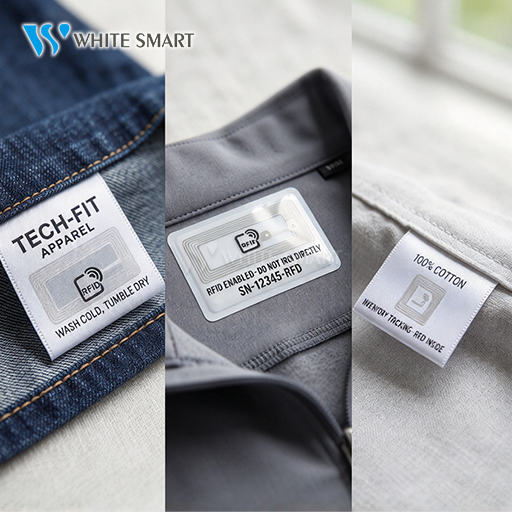
RFID Optician Tags
• Chip Technology: Dedicated chip solution, operating frequency HF 13.56MHz or UHF 860-960MHz.
• Communication Protocol: Supports ISO/IEC 14443, ultra-thin design, can be attached to the temples or inside the frame.
• Identification Performance: Reading distance 0-10cm, supports rapid inventory counting.
• Material & Process: Ultra-thin PET, 0.08mm thick, durable, adaptable to various application environments.
• Customization Services: Supports customized sizes, printing, and functions.
• Company Advantages: WS RFID provides a complete solution from tag production to system integration.
• Quality Certifications: Certified by the industry, RoHS, REACH, etc. • DPP-Compatible RFID tags
• Lead Time: 5-7 days for in-stock products; 10-12 days for products not in stock.
• Application Value: Improves management efficiency, reduces labor costs, and enables intelligent management.
RFID Optician Tags for Eyewear Retail: Precision Tracking with Ultra-Thin PET Design
RFID Optician Tags are dedicated RFID transponders for the eyeglasses business. These tags are manufactured by WS RFID, formed in 2008, and operating from a 10,000+ sqm facility with an annual production of over 500 million units. The tags are composed of ultra-thin PET at 0.08mm and support HF 13.56MHz and UHF 860–960MHz. With a failure rate of less than 0.5% and data retention of more than 10 years, they provide optical retailers and distributors a long-lived solution for frame monitoring, inventory management and supply chain insight.
What Are RFID Optician Tags?
One optical business may have hundreds of frame types. Manual counting of SKUs is a time-consuming and error-prone process, especially during seasonal resets or stocktakes across several drawers and display stands.
RFID Optician Tags are affixed directly to the temple or bridge of an eyeglass frame so shop workers may scan thousands of frames in one pass with much more data accuracy than manual approaches.
These tags use the EPC Class 1 Gen 2 protocol for UHF and the ISO/IEC 14443 protocol for HF. This makes the tags compatible with most common RFID readers and management systems. They are also in favour of Digital Product Passport (DPP) regulations, which are becoming more important to European eyewear businesses.
Key Technical Specifications
| Parameter | Details |
|---|---|
| Operating Frequency | HF 13.56MHz or UHF 860–960MHz |
| Communication Protocol | ISO/IEC 14443 or EPC Gen2 |
| Reading Distance | 0–10cm (HF) / Up to 1–3m (UHF, antenna-dependent) |
| Storage Capacity | 96bit / 128bit / 512bit EPC; user area optional |
| Data Retention | Over 10 years; 100,000+ write/erase cycles |
| Operating Temperature | -40°C to +85°C |
| Material | Ultra-thin PET, 0.08mm thick |
| Chip Models | Impinj Monza, Alien Higgs, NXP UCODE |
| Installation Methods | Adhesive, sewing, riveting, hanging |
| Size | Multiple sizes available, micro to large |
| MOQ | 500 units |
| Lead Time | 5–7 days (in-stock); 10–12 days (out-of-stock) |
Physical Design & Material Properties
Crafted from 0.08mm PET, the tag is almost undetectable on every frame, from high-end acetate to lightweight TR90.
A lot of designs use a flag configuration, where the antenna extends out from the frame body. This establishes a physical space between the inlay and any metal temple, therefore minimising signal detuning from metallic objects or skin contact during try-on.
The adhesives are non-migratory and pH neutral and pass chemical stability testing to ensure they don’t discolour or harm sensitive frame coatings. Also contains UV stability so that it will not yellow under showroom lights.

Quality Control Standards
Every RFID Optician Tag is 100% checked for chip to antenna continuity and EPC memory reading before delivery.
Testing in accordance with ASTM D3330 standards confirms the adhesive peel strength on frame materials such as acetate, titanium and TR90, indicating that the tag remains on and leaves no residue.
The RF sensitivity mapping is done such that each tag is over a certain decibel in the global UHF frequency band so that there are no dead zones during bulk scans. Environmental stress testing (thermal cycling per ISO 16750-4 and humidity resistance) verifies performance in diverse climates during international transportation.
WS RFID is ISO 9001:2015 certified, and our devices are RoHS, REACH, CE and FCC compliant. The manufacturing faults rate is fixed at 0.5%.

Application Scenarios
Retail Inventory Management
Store associates utilise portable RFID scanners to do blind counts of the complete display drawers. Tags can be read with a circular polarised reader at rates more than 100 tags per second even with tightly packed frames.
Optical Lab & Supply Chain Visibility
Tags are attached at the site of production or distribution, tracing each frame through the lens-fitting process. This eliminates human input mistakes and makes sure the correct frame is linked to the correct patient order.
Intelligent Showroom Analytics
Shelf-integrated antennae track the frequency at which certain frames are taken off the screens. This try-on frequency data provides businesses a quantifiable benchmark for optimising seasonal collections beyond sales statistics.
Warehousing & Anti-Theft
Tags enable inbound/outbound control, automatic stock reconciliation and connection with ERP or current management systems, eliminating human work and increasing data transparency throughout the supply chain.

Customization & OEM/ODM Services
WS RFID can provide complete OEM and ODM manufacture of RFID Optician Tags, MOQ 500pcs.
Specify chip model (Impinj Monza, Alien Higgs, NXP UCODE), memory capacity, size, print layout and installation format. We can build custom antennas and do RF simulations in-house.
For difficult conditions such as high temperature, high humidity or chemical exposure, enclosed tag variants are also available which are rated for ultrasonic bath resistance.
Variable Data Printing, Chip Pre-Encoding, ERP System Integration Support are available according to your project needs.

FAQ
Q1: Do the products impact the customer’s try-on experience?
A: Tags are created with an ultra-lightweight flag or wrap form that will not affect the balance or comfort of the frame.
Q2: How do these tags work with metal frames?
A: Some antenna layouts and spacer designs provide a physical distance between the inlay of the tag and the metal temple to reduce detuning without impacting read performance.
Q3: Are the tags resistant to ultrasonic cleaning cycles?
A: Standard adhesive labels are not rated for this use. WS RFID provides as an extra option specific encapsulated products for ultrasonic bath resistance.
Q4: Are the adhesives safe for high-end designer frames?
A: All adhesives are non-migratory and pH neutral, passing chemical stability testing to prevent discolouration or damage to frame coatings.
Q5: Which memory choices are available?
A: Tags support 96-bit, 128-bit and 512-bit EPC memory, with optional user memory sections. The data stays for more than 10 years and can survive more than 100,000 write/erase cycles.
Contact Us
Do you have more questions about RFID Optician Tags? For sample inquiries or product questions, contact us at kenny@w-srfid.com. MOQ starts from 500 units.