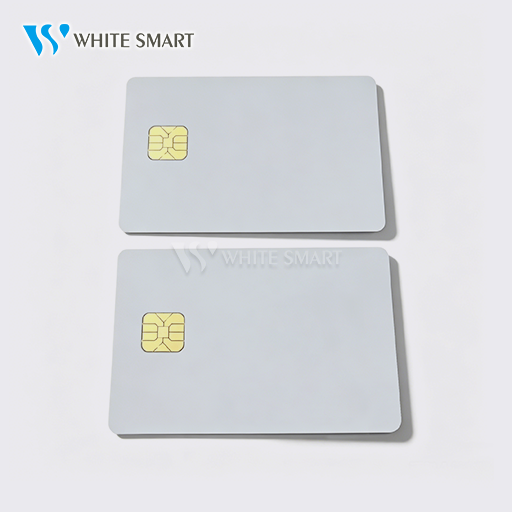
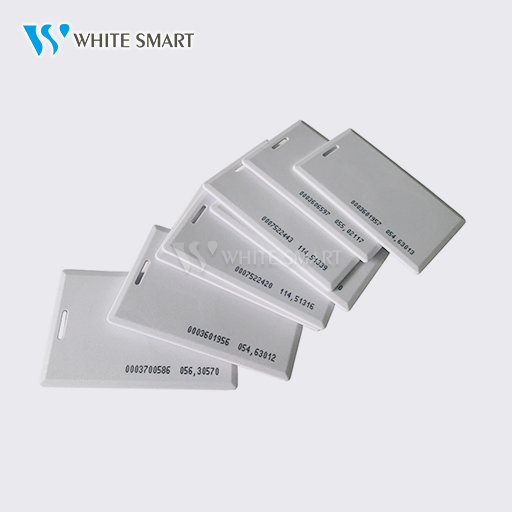
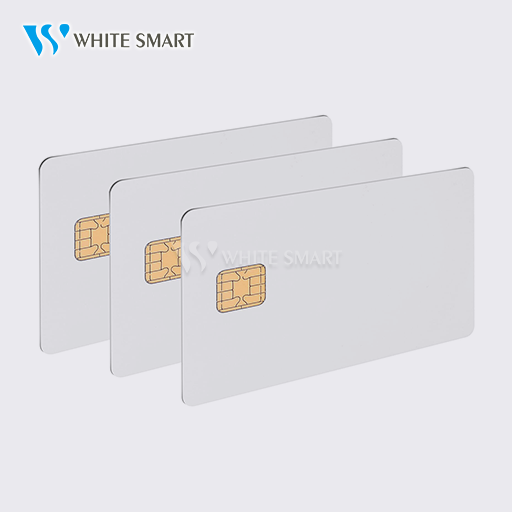
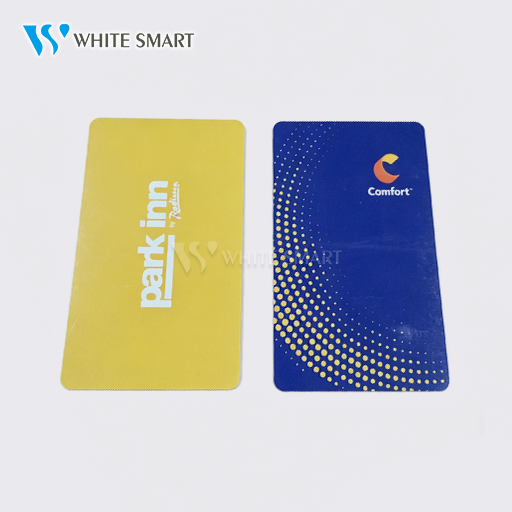
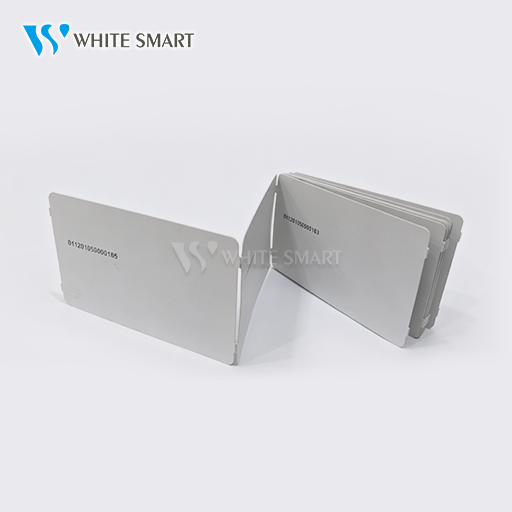
RFID Contactless Card
• Chip Technology: RFID technology, operating frequency 13.56MHz (HF), 125kHz-134kHz.
• Communication Protocol: ISO14443A, 15693, etc.
• Material and Process: High-quality PVC material, thickness 0.76-0.84mm (standard thickness).
• Customization Services: Supports brand logo printing, personalized coding, and custom sizes.
• Security Features: Encrypted data transmission, anti-copying and anti-cloning, secure and reliable.
• Company Advantages: WS RFID provides one-stop service from chip selection to finished product delivery.
• Quality Certification: Passed RoHS, REACH, and other international environmental certifications.
• Lead Time: 5-7 days for in-stock products; 10-12 days for products not in stock.
• Application Scenarios: Hotel access control, corporate attendance systems, residential community access control, etc.
RFID Contactless Card for Access Control — Fast, Secure & Fully Customizable
WS RFID produces all access control products based on RFID Contactless Card technology. Founded in 2008, with a plant of more than 10,000 sqm, WS RFID manufactures more than 500 million pieces each year. They are PVC cards, the usual CR80 size (85.5 × 54mm, thickness 0.76–0.84mm) and work on the 13.56MHz or 125kHz–134kHz. • Production failure rate < 0.1%. • Data retention > 10 years under typical usage circumstances.
What Is an RFID Contactless Card?
An RFID contactless card has an IC chip and an antenna inside It transmits data via radio frequency signals to a suitable reader – no need for interaction.
Most actual deployments are in two frequency bands. HF cards operating at 13.56MHz are compatible with ISO/IEC 14443A or ISO 15693 protocols and feature read/write memory, programmable data and cryptographic security functionalities. LF cards operating at 125kHz–134kHz have a set serial number and are suitable for basic, low-cost systems where enhanced security is not required.
Contactless cards do not have exposed contact points as magnetic stripe cards do. This minimises mechanical wear at common entry terminals and enables for quicker throughput at busy checkpoints such as turnstiles and parking barriers.
Product Specifications
| Parameter | Details |
|---|---|
| Standard Size | CR80 — 85.5 × 54mm |
| Card Thickness | 0.76 – 0.84mm |
| Operating Frequency | 13.56MHz (HF) / 125kHz–134kHz (LF) |
| Communication Protocol | ISO/IEC 14443A, ISO 15693 |
| Read/Write Distance | 0 – 10cm |
| Storage Capacity | 1KB / 4KB / 8KB EEPROM |
| Data Retention | 10+ years |
| Write/Erase Cycles | 100,000+ cycles |
| Operating Temperature | -25°C to +70°C |
| Material | PVC |
| Printing Process | Offset, screen printing, digital printing, full-color CMYK |
| Chip Options | NXP MIFARE series, DESFire series, Ntag series, ICODE series, Hitag series, Fudan Microelectronics, Huada Electronics |
Key Product Features
Non-contact reading at 0–10cm
The internal LC antenna circuit of the card is responsive in milliseconds. This speed of reaction is important for turnstiles, parking barriers and lift panels where little delays add up to congestion during rush hours.
Multi-band support
You have the choice of HF 13.56MHz or LF 125kHz choices based on your current reader infrastructure. Both frequency bands are widely used in access control systems all around the globe.
Waterproof design
During the manufacturing process, the chip and antenna are embedded between bonded layers of PVC. This construction resists moisture for use in applications such as locker rooms, outdoor kiosks and parking facilities.
HF cards cryptographic security
Cards supporting MIFARE DESFire EV3 or other HF protocols provide mutual authentication and AES-128 encryption. This makes it far more difficult to copy unauthorised than simple UID only LF cards.
In-line quality control in automated manufacturing
WS RFID manufacturing lines are equipped with Muehlbauer bonding equipment and Voyantic Tagformance testing devices. Continuous in-line monitoring keeps the batch failure rates below 0.1%.

Typical Applications
Access control is the primary use case, though the same card format also supports closed-loop micropayments in canteen or resort environments.
- Corporate offices — employee attendance, floor access, elevator control
- Residential communities — resident entry, visitor registration
- Campus environments — dormitory access, library management
- Hotels — guest room entry, common area access
- Parking systems — vehicle entry, parking space management
- Industrial parks — production zone access, equipment tracking
- Government facilities — secure zone entry, document management
- Financial institutions — vault access, restricted area control

Quality Control Process
Each batch of cards undergoes a prescribed process of inspections before shipping.
Bending and torsion tests according to ISO 10723 show that antenna-to-chip connection is maintained despite repetitive mechanical stress. Peel strength tests are performed to ensure that PVC overlay layers are securely adhered to the card core over time. Resonance frequency and Q-factor tests are performed to assure uniform read range of each manufacturing batch. Cards are treated to salt spray and UV and temperature/humidity cycling to mimic lengthy outside or semi-outdoor usage. Every card undergoes a chip initialisation check before leaving the facility to ensure that the card has been encoded correctly and that the UID is consistent.

Customization and OEM/ODM Services
WS RFID handles the full production sequence from card design through to finished packaging.
Brand logo printing is available using offset, screen, or full-color digital printing methods. Chip programming, data initialization, and variable data encoding are all completed in-house. Custom card sizes are available alongside the standard CR80 format.
For specialized requirements — dual-interface cards, multi-application partitioning, or integration with specific access control platforms — the engineering team supports technical development from prototype through to production. Functional samples are typically ready within 7 working days.
MOQ starts at 500 units. In-stock products ship within 5–7 days. Custom or out-of-stock orders require 10–12 days. Reference samples for evaluation are provided free of charge.
Certifications and Standards
RFID contactless card are produced under an ISO 9001:2015 quality management system. Products comply with RoHS, REACH, and POPs environmental requirements. Communication protocol compliance follows ISO/IEC 14443, and physical and electrical characteristics are tested against ISO/IEC 7810 and ISO/IEC 10373-1.

FAQ
Q: Why does read range differ across installations?
A: The Read Range relies on the tuning and output power of the reader antenna. The metal surfaces and liquids might de-tune the card's internal LC circuit and reduce effective range. Most normal installations will be within the operating range of 2 to 8cm.
Q: Can a contactless RFID card be cloned?
A: 125kHz consumer-grade equipment can clone simple UID-only cards. Cards based on MIFARE DESFire EV3 or similar HF protocols need the right cryptographic keys to be able to read or write to the card . This makes it very impossible to replicate the card without authorisation .
Q: What is the difference between ID card and IC card?
A: 125Khz ID Cards Only send out a fixed serial number No on-board encryption or writing capabilities. IC cards operate at 13.56MHz and incorporate read/write memory, programmable data fields, and security logic. This makes them ideal for applications such as access control, micropayments, and multi-application use.
Q: Does the lamination do anything to the performance of the cards?
A: The chip and antenna performance are not impacted by regular laminating. Too much heat during high-speed lamination might harm the chip-to-antenna link. During the laminating process, WS RFID’s manufacturing lines monitor heat parameters.
Q: Are these cards water proof?
A: The internal chip and antenna are protected from water and humidity by the bonded PVC construction. The card functions well in humid conditions provided that the physical layers of the card are not destroyed.
Q: What chip options?
A: Available chips include whole NXP MIFARE range (Classic, DESFire, Ultralight), Ntag series, ICODE series, Hitag series and domestic alternatives from Fudan Microelectronics and Huada Electronics. The storage size may be selected from 1KB to 8KB EEPROM according to application needs.
Contact Us
Do you have more questions about RFID Contactless Card? For samples, specifications, or a custom quote, reach the team at kenny@w-srfid.com.