Top-rated RFID contactless cards for business access control
When you buy access control you know that the proximity card you pick may be the difference between a good and bad deployment. The most popular RFID contactless card systems in use today are 13.56 MHz (HF) or 125 kHz (LF) and conform to ISO/IEC 14443 and hence are compatible with most commercial card readers. WS RFID has been manufacturing proximity smart cards for corporate campuses, residential neighbourhoods and industrial parks for over 15 years. In this entire guide, you’ll find: technological essentials, how to pick, ordering logistics – so your next project comes in on time and on budget.
Understanding RFID Contactless Cards for Business Access Control
Before ordering in bulk, every technical engineer should know what is on the card and how it communicates with the reader. The need to know is in the three sub-sections below .
How the Technology Works
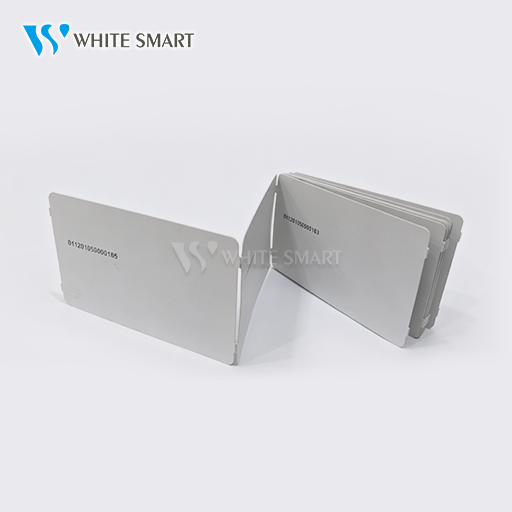
RFID contactless cards are flat copper or aluminium antennas with integrated IC chips, laminated onto a conventional CR80 PVC body (85.5 x 54 mm, 0.76-0.84 mm thick). The card is placed in the electromagnetic field of the reader, the antenna takes some of that energy and the chip speaks back the data it has stored. No batteries. *No touching. Depending on the antenna design and the reader output power, the distance for read/write is 0-10cm.
Frequency Bands and Card Types
Two families of proximity cards exist. LF cards working at 125 kHz-134 kHz (EM4100, HID Prox, Hitag series) have strong penetration on non-metallic surfaces and are excellent for parking and industrial gate systems. HF cards (13.56 MHz) - such as NXP Mifare Classic, Mifare DESFire, Ntag, ICODE and Fudan/Huada chip versions - provide faster data transmission speeds (up to 848 kbit/s), larger storage capacity (1 KB / 4 KB / 8 KB EEPROM) and cryptographic security that LF cards do not.
Key International Standards
The majority of HF access cards are ISO/IEC 14443 Type A, including the full Mifare family. ISO/IEC 15693 describes proximity cards for library and asset-tracking applications. If these requirements are adhered to then an RFID contactless card from one manufacturer will operate effectively with authorised readers from another manufacturer. This is crucial for integrators that bundle cards with proprietary devices.
Why Choose RFID Contactless Cards Over Other Access Control Technologies?
It takes about 1,000 swipes to wear out a magnetic stripe card, and the card itself is not encrypted. Wiegand contact cards send data over cables that aren't encrypted. A well-designed proximity smart card, on the other hand, completely stops mechanical wear and keeps data safe inside the chip.
Durability Advantage Over Magnetic Stripe Cards
RFID cards in PVC are writeable/erasable more than 100,000 times and have a data retention period of over 10 years. A continuous encapsulation process also waterproofs the card, enabling it to withstand laundry spills, rain and wet industrial floors without losing its signal. And so do magnetic stripe cards after a few months.
Security Advantage Over Basic ID Cards
Standard 125 kHz ID cards convey a fixed serial number and have no security, thus a replica may be created in seconds using an off-the-shelf duplicator. HF cards based on Mifare DESFire EV3 employ AES-128 mutual authentication. And that makes it difficult for anybody else to replicate it without authorisation. That security breach is very significant for government organisations, financial institutions and other sites that manage restricted regions.
Compatibility Advantage Over Proprietary Systems
The single model of ISO/IEC 14443-compliant cards may function with access control software from Hikvision, ZKTeco, Suprema and many more at the same time since they utilise an open protocol. That way installers don’t have to send out new cards each time a customer upgrades their reading hardware.
Top-rated RFID Contactless Cards for Business Access Control: Features & Benefits
Every premium proximity card has a standard set of anticipated, measurable qualities. Here are the key characteristics and advantages that make professional-grade cards superior than normal ones:
- Wide chip offering : NXP Mifare Classic 1K/4K, DESFire EV1/EV2/EV3, Ntag213/215/216, ICODE SLIX, Hitag S, Fudan FM11RF08 and Huada THM chip choices allow procurement engineers total freedom to align chip supply with reader firmware needs.
- Full colour custom printing: Offset, screen and digital CMYK printing all supported on the same production line allowing employee picture IDs, brand logos, QR codes and sequential numbering in a single print run.
- Defect rate < 0.1% WS RFID has fully automated bonding and lamination processes, and tests 100% of chips for initialisation after each manufacturing batch, keeping the field defect rate below 0.1%.
- Operating temperature range: Cards work consistently between -25 C and +70 C, suitable for cold-storage facilities and outdoor gate systems without the need for specific enclosures.
- RoHS and REACH approved: All materials fulfil EU environmental standards, which is vital for export projects to North American or European end customers.
These specs directly lead to lower RMA rates, faster site commissioning, and fewer calls about compatibility after deployment. Every time engineers test our examples, they report clean read performance across the whole 0–10 cm range, with no false rejects.
How to Select the Best RFID Contactless Card for Your Business Needs
It’s not a pricing list but a compatibility matrix that will assist you select the proper card. First, make sure the chip’s protocol works with the reader’s software. Then assess the safety of the supply chain and the overall cost of landing.
Step 1 — Confirm Frequency and Protocol
Ask the manufacturer that manufactured your reader for a list of chips that function with it. A Mifare Classic reader will not operate with a DESFire-only card even if the cards are both 13.56 MHz. There is no way you can read LF cards at 125 kHz with HF cards. Engineers don't bother locking down frequency and process prior to sampling.
Step 2 — Evaluate Chip Supply Stability
The access-card business was severely affected by a scarcity of chips between 2021 and 2023. For example, if a supplier has NXP, Fudan and Huada chips, they may swap manufacturing runs without affecting the way the RFID contactless card operates on the outside. “Before agreeing to a bulk order, be sure you understand your supplier’s buffer stock policy and the time frame they commit to for fulfilling your order.
Step 3 — Calculate Total Cost at Volume
One of the inputs is the unit price of a card. You will need to include in the cost of encoding, special print set-up, packing and import charges. Bulk order at WS RFID Encoding and printing at the same time Different rates Regular products in stock ship within 5-7 working days Custom order manufacturing runs are completed in 10 to 12 days after the order has been verified.
How to Use and Manage RFID Contactless Cards Effectively
It's easy to give out cards, but keeping them working over a multi-year deployment requires a small set of consistent steps.
Card Handling Best Practices
Stay away from strong magnetic fields and direct heat that stays above 70 °C for a long time. Put items that haven't been sent out yet in anti-static sleeves. Hold a card flat and straight to the reader face instead of at an angle when showing it. Misaligned presentation is the most common cause of read failures that users mistake for bad cards.
Troubleshooting Read Failures
If a card reader stops working, try it on a reader that does work first to make sure the chip isn't broken. Three main reasons are reader antenna detuning, firmware incompatibility after a software update, or a cracked internal antenna from being bent. Within one business day, WS RFID's technical support team responds and replaces samples that have been proven to have problems with the way they were made under warranty.
Bulk Ordering and Delivery Logistics
Request free sample cards, make sure they work with your reader, place a trial order of 500 to 1,000 units, check the quality, and agree on a minimum order quantity (MOQ) and a monthly delivery schedule. WS RFID ships from its factory in Shenzhen via DHL, FedEx, or sea freight, depending on the size of the order. Every shipment can be fully tracked.
Conclusion
Choosing the right proximity card for a business access control project comes down to three factors: protocol compatibility with your reader hardware, chip supply reliability over the project lifecycle, and a supplier capable of encoding, printing, and delivering on schedule. WS RFID's RFID contactless card portfolio—spanning LF 125 kHz through HF 13.56 MHz, with NXP, Fudan, and Huada chip options—covers the full spectrum of commercial and industrial access scenarios. With a defect rate below 0.1%, RoHS and REACH certification, and a 15-year manufacturing track record, we are a supplier worth testing.
FAQ
1.What is the difference between an LF and an HF proximity card?
LF cards work at 125 kHz and usually send a fixed ID number without encrypting it. HF cards work at 13.56 MHz, can read and write, can hold up to 8 KB of encrypted data, and are compliant with ISO/IEC 14443. HF cards are safer than other types of cards, so they are better for most business access control projects.
2.Can WS RFID print our company logo on the cards?
Yes, WS RFID can print in offset, screen, and digital CMYK on all standard PVC card cases. You can print full-color photos of employees, logos, sequential barcodes, and QR codes all at once, and there is no minimum print charge above the standard MOQ.
3.Are these cards compatible with third-party card readers?
Cards that are compliant with ISO/IEC 14443 Type A can be read by any authorized reader that uses the same protocol. This includes readers made by Hikvision, ZKTeco, Suprema, and HID Global. Before placing a large order, we suggest that you test the compatibility with your specific reader model. We offer free samples for this purpose.
4.What is the standard lead time for a custom order?
Standard cards in stock will be sent out within 5–7 business days. For custom orders that need specific chip programming, full-color printing, or non-standard encoding, production starts within 24 hours of artwork approval and ends 10–12 business days later.
5.How do I verify card security against cloning?
Ask for cards with Mifare DESFire EV2 or EV3 chips. These use AES-128 mutual authentication and sector-level encryption, which means that consumer cloning tools can't copy them. If you ask, WS RFID can give you proof that the chip is certified.
Partner with WS RFID for Your Next Access Control Card Project
WS RFID has been making direct RFID contactless card smart cards for 15 years, has an ISO 9001:2015 certification, and a factory in Shenzhen that can make 500 million units a year. Our all-in-one service includes choosing the chip, encoding the card, printing in full color, packaging, and shipping around the world. If you need a monthly supply agreement or 1,000 sample cards, email us at kenny@w-srfid.com or go to w-srfid.com to get a quote and free samples right away.
References
1. International Organization for Standardization. ISO/IEC 14443: Identification Cards — Contactless Integrated Circuit Cards — Proximity Cards. ISO, 2016.
2. International Organization for Standardization. ISO/IEC 15693: Identification Cards — Contactless Integrated Circuit Cards — Vicinity Cards. ISO, 2019.
3. NXP Semiconductors. MIFARE Classic EV1 — Product Data Sheet. NXP, 2022.
4. ASSA ABLOY. The Access Control Technology Report: Trends and Standards in Commercial Security. ASSA ABLOY Group, 2023.
5. IDTechEx Research. RFID Forecasts, Players and Opportunities 2023–2033. IDTechEx, 2023.
6. European Chemicals Agency. REACH Regulation (EC) No 1907/2006: Guidance for Manufacturers of Electrical and Electronic Equipment. ECHA, 2021.