RFID Jewelry Tags
• Chip Technology: Dedicated chip solution, operating frequency HF 13.56MHz or UHF 860-960MHz.
• Communication Protocol: Supports ISO/IEC 15693, miniaturized design, aesthetically pleasing and discreet, does not affect the appearance of jewelry.
• Identification Performance: Reading distance 0-1.5 meters, supports rapid inventory counting.
• Materials and Processes: Transparent PET or special paper, highly durable and adaptable to various application environments.
• Customization Services: Supports customized sizes, printing, and functions.
• Company Advantages: WS RFID provides a complete solution from tag production to system integration.
• Quality Certifications: Certified by the industry, RoHS, REACH, etc. • DPP-Compatible RFID tags
• Lead Time: 5-7 days for in-stock products; 10-12 days for products not in stock.
• Application Value: Improves management efficiency, reduces labor costs, and enables intelligent management.
RFID Jewelry Tags for Retail & Asset Tracking — Smart Inventory Management Solution
Retailers and wholesalers have the perpetual task of tracking thousands of pieces of jewellery located in display cases, storage vaults, and delivery systems. RFID Jewelry Tags are specialised HF or UHF transponders that provide a digital identification to each item, allowing for the mass, non-line-of-sight scanning of an entire display case in seconds. They operate at HF 13.56 MHz or UHF 860-960 MHz, support ISO/IEC 15693 and EPC Gen2 protocols and are designed to perform reliably on gold, silver and platinum surfaces.
What Are RFID Jewelry Tags?
Each tag has a permanent, TID on the chip. Unlike barcodes, the tag does not have to be visible or scanned separately, a single pass of a scanner over a tray will identify every item at the same time.
The antenna is a flag-shaped or a loop antenna with a tail free of glue. The loop keeps the tag to the object without any glue touching the precious gemstone or metal surfaces, which is the main worry for pearls, opals and untreated stones.
Tags are available in HF or UHF models. HF is most often used for single item tabletop readers and smart display trays. UHF is used for handheld inventory scanning, gate checking and receiving in the warehouse.
Technical Specifications
| Parameter | Details |
|---|---|
| Operating Frequency | HF 13.56 MHz or UHF 860–960 MHz |
| Communication Protocol | ISO/IEC 15693 or EPC Class 1 Gen2 |
| Reading Distance | 0–1.5 m (up to 3–5 m in open environments) |
| Storage Capacity | 96-bit / 128-bit / 512-bit EPC; optional user memory |
| Data Retention | 10+ years; 100,000+ write/erase cycles |
| Operating Temperature | −40°C to +85°C |
| Substrate Material | Transparent PET or specialty paper |
| Chip Options | Impinj Monza, Alien Higgs, NXP UCODE series |
| Installation Methods | Adhesive, sewing, riveting, hanging |
| MOQ | 500 units |
| Lead Time | 5–7 business days (stock items); 10–12 business days (custom orders) |
Key Product Features
Minimal Visual Impact
The tags are printed on a clear PET or speciality paper base. A practical necessity for luxury retail venues is that presentation directly impacts perceived value . Their small form factor does not much change the presentation of jewellery on display .
Suppression of Metal Interference
Gold and silver naturally block RF waves. The flag-like form of the antenna leads to an air gap between the tag and the metal surface. Such a gap avoids signal detuning and enables the tag to be read reliably in batch-scanning operations.
Chemical and environmental stability
Encapsulated versions are IP68 approved for conditions that include ultrasonic cleaning cycles, steam operations and humidity exposure. The operational temperature range of -40 °C to +85 °C covers most storage and travel scenarios.
Tamper Evident Design
Tags with tamper-evident slots interrupt the antenna circuit when cut or removed. The tag will no longer react to readers after the circuit is broken, providing a detectable warning that an item may have been tampered with or swapped.
Compliance with Digital Product Passport (DPP)
RFID Jewelry Tags are compatible with DPP data structures that enable brands to include origin, material composition and lifespan information right on the tag. This is important for businesses planning for EU traceability and consumer disclosure obligations.

Quality and Testing
WS RFID employs Voyantic Tagformance equipment to assess RF sensitivity and Muehlbauer bonding lines to connect chips. The main stages in testing are:
- Minimum activation power measurement throughout the worldwide frequency range of 860-960 MHz Sensitivity testing
- Adhesive shear and residue testing: Confirming the absence of chemical residue on gold or platinum surfaces after tag removal
- Environmental stress screening: Temperature cycling over the specified range to test chip to antenna bond integrity
- ESD robustness testing: Simulation of static discharge from synthetic display textiles and handling .
- Print durability verification: Ensuring thermal transfer output at 300-600 DPI stays readable via routine retail usage
The industry standard RF measuring platform for characterisation of tag sensitivity and read range under well controlled settings is the Voyantic Tagformance. Muehlbauer bonding lines enable the precise positioning of chips in tiny scale jewellery tag antennas.

Where RFID Jewelry Tags Are Used
Jewelry Retail Inventory
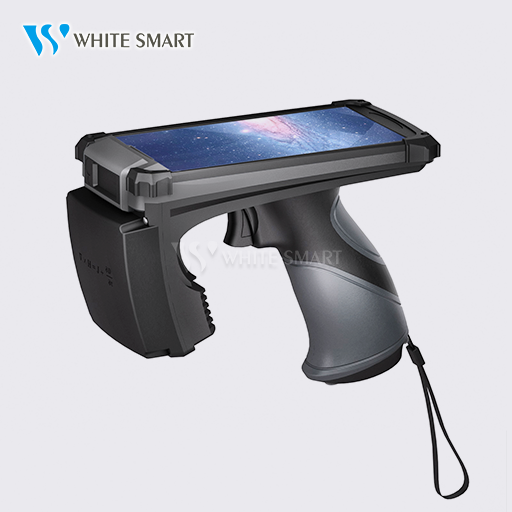
Staff utilise portable UHF readers to scan display cases without having to pull each item out. Items that are misplaced, missing, or not on the intended tray are flagged in real time.
Smart Interactive Display
If a tagged item is taken out of a tray with NFC or UHF capability, an integrated reader may activate a linked display with product information, sourcing and style material. This also tracks the time of consumer engagement for retail analytics.
Secure Logistics & Distribution
Gate readers may also be used in wholesale and distribution settings to confirm the contents of sealed boxes to the shipping manifests , without opening the boxes . This preserves chain of custody at every stage of transfer .
Authentication & Brand Protection
All tags have a factory programd TID that cannot be reproduced. Brands are using this for product authentication procedures, authorised reseller verification and customer-facing provenance verification.
Other Applications
The same tag infrastructure is used for jewellery repair tracking, auction item administration, insurance asset registration, warehouse inbound/outbound logging and exhibition security.

Customization and OEM/ODM
WS RFID is customisable from chip selection to the final label. Choices are:
- Tag Size: All tag sizes include compact and standard label sizes
- Substrate: Clear PET or speciality paper
- Chip selection: Impinj Monza, Alien Higgs, NXP UCODE and other compatible chips
- Printing: 300-600 DPI Logo, QR Code, 2D Barcode via Thermal Transfer
- Pre-encoding ERP System and Variable data Serialisation
- Special variants: high temperature, low temperature, high humidity settings
Functional examples for bespoke requirements are usually available in 7 working days. At the sample stage, integration with ERP or warehouse management systems might be addressed.
Certifications
WS RFID is ISO 9001:2015 quality management certified. Products comply with CE, FCC and RoHS standards. RFID Jewelry Tags are checked for chemical residue in the materials used to ensure that they are suitable for interaction with valuable metals and stones.

FAQ
Q: Will the glue harm delicate stones like pearls or opals?
A: No. The flag or loop design affixes the tag to the merchandise without any adhesive coming in contact with the gemstone surface. The adhesive contact point is restricted to the tag tail that adheres to the jewellery finding or mounting hardware.
Q: How do these tags perform close to gold/silver?
A: The flag-shaped antenna produces air space between the tag and the metal. This minimises the signal detuning from conductive surfaces and provides uniform read performance in batch-scanning settings.
Q: Are the tags suitable for ultrasonic cleaning?
A: IP68 certified enclosed versions are built for ultrasonic cleaning settings including the vibration, heat and moisture such cycles require. Immersion standard non-encapuslated tags are not advised.
Q: What if a tag is cut or otherwise interfered with?
A: Tamper obvious tags have a cut in the antenna circuit. If the tag is cut or forcefully removed, the circuit is broken and the tag ceases to react. This means that any manipulation is detected at the following scan.
Q: Can you print logos and QR codes on little tags?
A: Yes. The tag surface also allows for 300–600 DPI thermal transfer printing of logos, QR codes and 2D barcodes in addition to encoded RFID data.
Q: What is the MOQ?
A: MOQ is 500 pieces. We have samples from our current stock available. Terms on special samples may be arranged depending on your particular needs.
Contact Us
Do you have more questions about RFID Jewelry Tags? For samples, pricing, or a custom specification discussion, reach our team directly at kenny@w-srfid.com.