RFID Blocking Card
• Shielding Range: Covers the entire frequency band from 125kHz to 960MHz, shielding RFID/NFC signals and protecting privacy.
• Shielding Effectiveness: Shielding effectiveness of over 99.9%, effectively preventing information leakage.
• Materials and Process: Special metal composite material, 0.3-0.5mm thick, lightweight and portable.
• Usage: Simply place the card next to an RFID/NFC card for shielding.
• Protected Items: Bank cards, ID cards, access cards, transportation cards, etc.
• Company Advantages: WS RFID uses advanced shielding technology to protect customer privacy.
• Quality Certification: Passed electromagnetic compatibility testing, safe and reliable.
• Lead Time: 5-7 days for in-stock products; 10-12 days for products not in stock.
• Application Value: Prevents e-wallet fraud, protects personal privacy, and enhances security.
RFID Blocking Card for Wallets & Passports
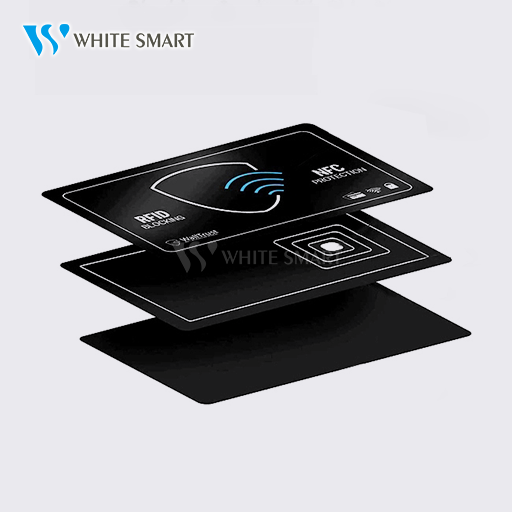
Unauthorised contactless scanning is a known security problem in crowded places - airports, transport stations and public locations where portable RFID scanners may pick up card data without physical contact. The WS RFID's RFID Blocking Card is a passive device that does not need a battery and is meant to disrupt that process. The card is manufactured to CR80 standard dimensions (85.5 × 54mm) and is 0.3–0.5mm thick, so it fits any wallet slot and needs no setup, no charging and no maintenance.
What Is an RFID Blocking Card and Why Does It Matter?
Radio frequency is used to communicate via contactless bank cards, e-passports, transport cards and access badges. This convenience also implies that a nearby reader—even one that you are unaware of—can request a data exchange.
You have an RFID blocking card in your wallet that produces an interference field when it detects a reader signal. It feeds off of the reader's own electromagnetic field, and then reacts with a jamming signal that prevents any data from being communicated. No action is requested from you.
Frequency Coverage
Most contactless payment cards and e-passports work at 13.56MHz. Low frequency proximity cards, such as those used for building entry, operate at 125kHz. Some of the latest ID systems go as high as 960 MHz.
The WS RFID blocking card covers the whole 125kHz-960MHz spectrum, creating a 2-5cm shielding zone capable of protecting several cards simultaneously. For a thick bifold wallet, we may put one card on each side to cover the space across both parts.
Technical Specifications
| Parameter | Details |
|---|---|
| Shielding Frequency Band | 125kHz – 960MHz |
| Shielding Effectiveness | ≥99.9% |
| Material | Metal composite |
| Thickness | 0.3 – 0.5mm |
| Dimensions | 85.5 × 54mm (CR80 standard) |
| Operating Temperature | -20°C to +60°C |
| Service Life | 5+ years |
| Power Source | None — passive design |
| Packaging | Card sleeve included |
How the Shielding Works?
The card is based on a Faraday-layer composite construction with a passive induction module. When the RFID reader creates an electromagnetic field within range, the card absorbs that energy and sends out a jamming signal that prevents any readable signal from reaching the cards behind the jamming card.
The inner metallic layers are meant to prevent oxidation. The card passes ISO 7810 bend and torsion testing, suggesting the interior construction is built to stay intact under normal wallet usage for the claimed service life.

Quality Verification
Each product undergoes a testing regimen before shipping:
- Network Analyser Testing – confirms resonance frequency & attenuation levels (>40dB @ 13.56MHz) ISO 7810 Bending & Torsion Tests – guarantees internal antenna stays undamaged after repetitive flexing
- Lamination Adhesion Test – tests for delamination under pressure
- Simulated Scanning Test – Performed using commercial NFC scanners to check that no data is sent
- Salt Spray & Humidity Ageing — tests resistance of inner metal layers to oxidation
The RFID blocking card is certified to ISO 9001:2015, CE, FCC, RoHS, REACH, and POPs.

Typical Use Cases
Personal and travel use: Used by commuters and regular travellers to secure bank cards, passports and transit cards in high-traffic settings.
Corporate security: Issued by companies to employees to minimise the possibility of cloning access credentials in common public areas.
Financial services: Banks and insurance companies include it as a security feature to cardholders.
Healthcare and education: Hospitals and colleges utilise it to help secure health insurance cards, patient access credentials, student IDs and campus cards.
Government: Used as an added layer of security for official identity papers in field locations.

OEM and ODM Options
WS RFID supports OEM and ODM production for brands, financial institutions, corporate gifting programs, and security product distributors.
Available options include:
- Logo printing and custom branding
- Personalized card sleeve design
- Chip encoding and variable data printing
- Custom retail or enterprise packaging
- Functional prototypes available within 7 working days
MOQ starts at 500 units. In-stock lead time is 5–7 days; out-of-stock lead time is 10–12 days. Existing samples are available at no charge.

FAQ
Q: Does the card require batteries?
A: Nope. It employs passive induction, and scavenges power from the reader’s signal to trigger its jamming reaction. No charge, no upkeep.
Q: Will it affect my phone, wifi or bluetooth ?
A: No. The card is exclusively for RFID and NFC frequencies. It does not impact GSM, 4G/5G, Wi-Fi or Bluetooth.
Q: Will one card be enough for my whole wallet?
A: Yes, in most regular wallets. The shielding zone is 2–5cm from the card For the bigger bifold wallets, one card on each side gives you more coverage.
Q: Does it block 125kHz cards?
A: The frequency range is rated from 125kHz to 960MHz, which covers low frequency proximity cards. The desired frequency range must be specified before ordering.
Q: How long is it?
A: Rated Service Life: 5+ years of typical usage If the card is physically damaged or exposed to temperatures higher than +60°C performance may be impacted.
Q: Can I obtain a custom branded version?
A: Yes, OEM & ODM customisation is possible, such logo printing, sleeve design and packaging.
Contact Us
Do you have more questions about RFID Blocking Card? To request samples or discuss a custom project, reach WS RFID at kenny@w-srfid.com.