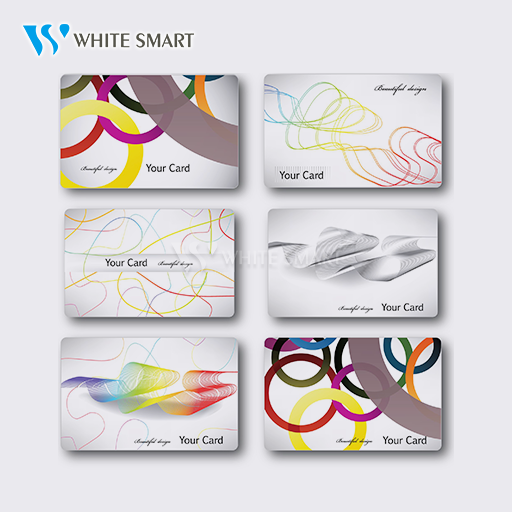
Contactless Payment Cards
• Chip Technology: Employs a secure chip solution, operating at 13.56MHz (HF high frequency).
• Communication Protocol: Supports ISO/IEC 14443 and EMV payment standards, compliant with financial payment security standards, and supports fast payments.
• Security Features: DES/3DES/AES encryption algorithms, resistant to attacks and cracking, compliant with financial security standards.
• Materials and Processes: High-quality PVC/PET material, 0.76-0.84mm thick, highly durable.
• Customization Services: Supports brand logo printing, personalized coding, and special function customization.
• Company Advantages: WS RFID provides complete solutions from chip selection to system integration.
• Quality Certifications: Certified by RoHS, REACH, and financial security authorities.
• Lead Time: 5-7 days for in-stock products; 10-12 days for products not in stock.
• Application Scenarios: Identity recognition, mobile payment, membership management, access control, and attendance systems.
Contactless Payment Cards for Enterprise Payment and Identity Programs
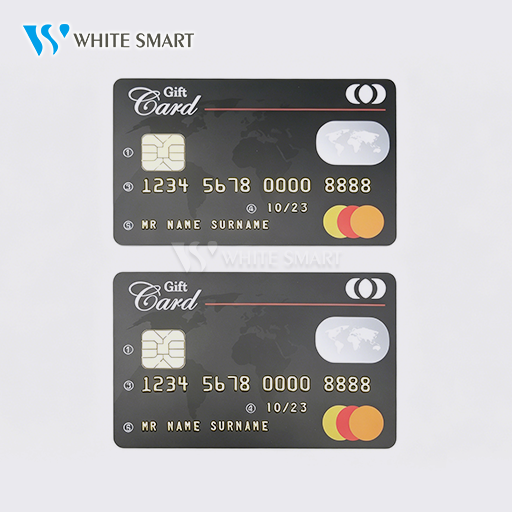
Contactless Payment Cards are equipped with NFC technology working at 13.56 MHz based on ISO/IEC 14443 to perform transactions without physical touch. WS RFID has been producing these cards since 2008 and has been a supplier to banks, transport operators, campuses and government initiatives. Each card is produced on PVC, PET or PC at a thickness of 0.76-0.84 mm and integrated with NXP SmartMX, Infineon SLE or Huada Electronics chips. All cards are tested to EMV and Common Criteria EAL4+ before being sent.
What Are Contactless Payment Cards?
Constant usage of the classic contact cards wears down the terminal headers and chip surfaces. They also cause a bottleneck in the checkout queue and generate hygiene problems at common touch points.
Contactless cards solve these problems, they send data on 13.56 MHz RF signal at read distance 0-4 cm. A transaction takes milliseconds. No swiping, no inputting, no touching the terminal.
The integrated secure microcontroller is connected to an etched copper or silver-ink antenna coil via a flip-chip or wire-bonding method. High-traffic scenarios where speed and reliability matter benefit from data transmission speeds of up to 848 kbit/s.
Technical Specifications
| Parameter | Details |
|---|---|
| Standard Size | CR80 (85.5 × 54 mm) |
| Card Thickness | 0.76 – 0.84 mm |
| Operating Frequency | 13.56 MHz (HF) |
| Communication Protocol | ISO/IEC 14443, EMV Payment Standard |
| Read/Write Distance | 0 – 4 cm |
| Data Transfer Rate | Up to 848 kbit/s |
| Storage Capacity | 1 KB / 4 KB / 8 KB / 72 KB EEPROM (configurable) |
| Security Rating | Common Criteria EAL4+ |
| Data Retention | 10+ years; 100,000+ write/erase cycles |
| Operating Temperature | -25°C to +70°C |
| Chip Options | NXP SmartMX, Infineon SLE, Huada Electronics |
| Substrate Materials | PVC, PET, PC, ABS |
| Encryption | DES / 3DES / AES |
| Certifications | RoHS, REACH, EMVCo L1/L2, ISO 9001:2015 |
Security Architecture
Each Contactless Payment Cards employs DES, 3DES or AES encryption. Every EMV transaction creates a dynamic cryptogram, so the captured signal data can’t be used to replay a transaction or clone the card.
The chip is rated at Common Criteria EAL4+, the same certification used for identification papers issued by governments and banking-grade cards. This is an externally assessed certification, not a self-declared label.
This dynamic authentication methodology is what separates EMV-compliant cards from older magnetic stripe technology – static card data on a magnetic stripe may be duplicated; a dynamic cryptogram produced per transaction cannot.

Where These Cards Are Used?
Mass Transit: These cards validate in milliseconds in the bus and underground environment where electromagnetic interference is rampant. This speed and compatibility are critical for open-loop transport networks, where users may use the same card issued by their bank across numerous operators.
Retail and Quick Service Restaurants – No PIN input needed for low-value transactions when regional cardholder verification limitations allow. For food courts, convenience shops and supermarkets, this decreases line friction during busy times.
Corporate Environments: One card for entry control to buildings, login to workstations and cashless cafeteria purchases. This convergence minimises the amount of credentials that workers carry.
Campus and Government Programs Campus cards are accepted for cafeteria purchases, library checkouts, and in-campus shops. Social security, medical reimbursements and welfare paid using government issued cards. Shared platform.
Tourism and Cross-Border Use: Cards may be used for ticketing scenic spots, hotel purchases and settlement of multi-currency transactions, which is beneficial for travel-oriented programs running across borders.

Quality Control Process
Each lot of manufacturing is subjected to a defined quality control procedure via WS RFID. Resonance frequency and Q-factor measurements confirm the proper tuning of the antenna for various terminal types.
The dynamic bending and torsion stress tests in accordance with ISO/IEC 10373-1 replicate the stresses of repetitive wallet storage. The most prevalent contactless failure mode is a micro-fracture of the internal antenna loop from bending - this destroys RF operation while the contact chip remains functional. The purpose of this test is to detect bad antenna bonds before the cards ship.
The peel strength research indicates that the overlay and core layers continue to bond in situations of humidity or high temperature. Prior to embossing, the IC module is inspected using X-ray to verify placement correctness. EMV L1/L2 analogue and digital protocol testing validates that the cryptographic handshake stack is behaving as required.
The salt spray and heat cycling tests demonstrate corrosion resistance of the copper antenna and no deformation of the plastic substrate under environmental stress.
Customization and OEM Services
WS RFID supports OEM and ODM production with a minimum order of 500 units. Available customization includes brand logo printing, personalized chip encoding, variable data printing, and custom function development.
Contactless Payment Cards applet development and system integration are both supported. If your project requires a custom payment application or needs to connect to an existing management platform, the engineering team can discuss the technical requirements with you directly.
Functional samples can be ready within 7 working days. Existing samples ship without charge; terms for new sample development are discussed case by case. Lead times are 5–7 days for in-stock products and 10–12 days for production runs on out-of-stock configurations.

Application Areas
- Retail POS and mobile payment terminals
- Bus, subway, and taxi electronic ticketing
- Campus meal cards and library systems
- Employee meal and benefit cards
- Government social security and medical payment programs
- Membership and loyalty card programs
- Hotel key cards and tourism ticketing
- Cross-border multi-currency transaction cards

FAQ
Q: Why would a contactless payment card cease operating yet the contact chip still works?
A: That usually means a micro-fracture in the internal antenna loop from too much bending. The contact pads are not impacted by the fracture that disrupts the RF circuit. Stress testing in manufacturing aims to find weak antenna bonds before the cards leave the factory.
Q: Can the products be skimmed?
A: EMV standards provide a dynamic cryptogram for each transaction. The intercepted signal data cannot be used to clone the card or replay the transaction, which is the primary technological distinction from static magnetic stripe data.
Q. What is the difference between ISO 14443 type A and type B?
A: They employ various modulation and anti-collision encodings. Many of today’s cards offer both kinds so that they are compatible with terminals in various markets and areas.
Q: What is the impact of metal cards on contactless performance?
A: Metal enclosures restrict RF waves , acting as a Faraday cage . Metal card designs need particular antenna configurations or back-plate materials that don't hide the RF signal to enable the RF signal to travel appropriately.
Q: What are the EEPROM storage options?
A: Cards are available with 1 KB, 4 KB, 8 KB and 72 KB EEPROM. The right capacity relies on how many apps and data records the card has to accommodate.
Contact Us
To request samples or discuss your Contactless Payment Cards project, contact WS RFID at kenny@w-srfid.com. We respond to technical and sourcing inquiries directly.